Concrete Demolition in Montgomery County, TX — Breaking Out the Old Slab, Hauling It, and What Comes Next
Conroe Concrete Works does concrete demolition in Montgomery County, TX as the first half of a replacement, not as a separate trade: the old driveway, walk or pad gets broken out, loaded and hauled, and the tear-out line on the quote is the same $2–$3 per square foot the driveway page has published all along.
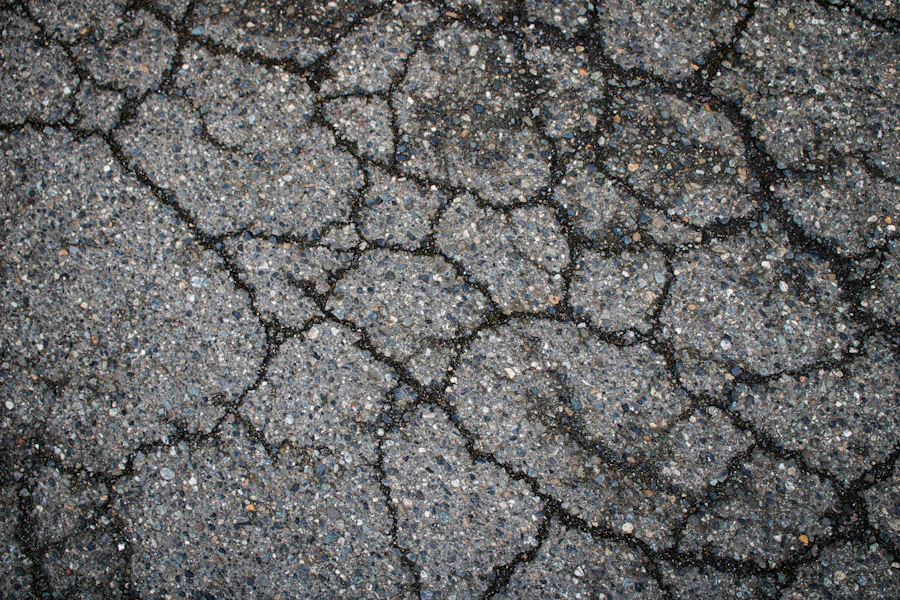
What tear-out means on a residential job
Concrete demolition on a house lot is not a wrecking ball. It is a breaker on a skid steer or a hammer on a small excavator working the old slab into pieces a bucket can lift, a saw cut along the line where good concrete is staying, a loader filling a truck, and a truck making as many trips to the dump as the weight of the old pour demands. That last part is why the line is priced by what comes out and not by a guess: a builder-grade driveway poured thin on wire mesh breaks up quickly and loads light, while an eight-inch pad laced with rebar fights the breaker and rides to the dump in more loads, and the dump charges by the ton. On this site the tear-out and haul-off of an existing driveway runs $2–$3 per square foot on top of the new pour, and the quote names the thickness and the steel it was priced on.
What is usually under the old slab
The most useful thing a demolition reveals is the reason the old concrete failed. Nine times in ten around Conroe the answer is the same: there was nothing under it. A slab poured straight onto raked, native gumbo clay with no compacted base has spent every wet spring and dry August riding the ground up and down, and once it is out you can see the bare clay it sat on. Other finds are common enough to plan for. Old concrete under the topsoil that nobody knew about, a previous walk or pad buried when the yard was regraded. Voids where roof water washed the clay out from under a corner. Oak roots that dried one side of the slab harder than the other. Each of those is exactly why a replacement is quoted as two lines, what comes out and what goes back, because the new pour goes down on a compacted, stabilized base with steel on chairs and joints on schedule, on ground that has been seen rather than assumed.
Buried lines: say so before the breaker starts
A breaker does not know what is under the slab it is hitting. Sprinkler lines that run under the drive to the front bed, low-voltage lighting wire, the cable to the gate opener, and on a septic lot the lateral that crosses the yard all need to be pointed out before the tear-out day, and the quote will ask. Marking them costs nothing; finding one with the bucket costs a repair and a day.
One panel or the whole run
Demolition is not always the whole driveway. When one or two panels have settled or cracked through and the rest of the slab is sound, the broken sections are saw-cut at the joint, broken out and poured back as their own section, doweled to the neighbors so the pieces move together. The Conroe concrete repair page prices that panel work at $9–$14 per square foot, high per foot because a small pour carries the same truck and crew as a big one, and it is the page that draws the line between a slab that can be lifted and one that has to come out. Once cracking runs through most of the slab and the base has clearly failed, partial work is money spent twice, and the honest quote is the full tear-out.
The approach at the street
Where a driveway meets a county-maintained road the strip at the street is its own question. The terms page already says it plainly: a new approach there may need a driveway or culvert permit through the precinct commissioner's office for your area, and that permit is the property owner's to obtain. On a tear-out that reaches the road we say when it applies before anything is broken at the ditch line, and on rural frontage the approach is the piece that gets poured thicker and with steel carried across the culvert line, because it takes the hardest use on the property.
What replacement really costs, added up
Two lines, both already public on this site. The tear-out at $2–$3 per square foot of old slab, and the new driveway at $6–$10 per square foot for a broom finish on prepared base, which is the rate the driveway page multiplies out by driveway size, from a single-car strip to a circle drive. On the 600-square-foot two-car driveway that page uses as its example, the tear-out is that rate times that footage, written as its own line on the quote, and the new pour is priced beside it, so what the new Conroe driveway costs once the old one is out is never a surprise and never a blended number nobody can check. The same two-line arithmetic applies to a patio, a walk or a shop pad; only the second line's rate changes.
Demolition words on the quote
A breaker is the hydraulic hammer that fractures the slab; a saw cut is the clean line where the demolition stops. Haul-off is loading and trucking the rubble, and tonnage is what the dump charges on. The subgrade is the ground exposed once the slab is gone, and select fill is the material built up over it where the clay is too soft to pour on. A dowel ties a new section to an old one.
Tear-out questions
What does removing a concrete driveway cost in Montgomery County?
Can you tear out just the broken part of a driveway?
Do you haul the old concrete away?
Tear-out and re-pour, quoted as two honest lines
Conroe, Willis, Montgomery, Magnolia & New Caney.
Start a Concrete Quote